So here is where we are these days:
Mari is suddenly very interested in words. Unlike Austin, she has not taken to reading early; instead, she likes writing. So she's learning to spell so she can write little notes, not so she can read a book. Maybe this is in reaction to her brother, but in any case this week she has been spelling out words as we bike to school "S-T-O-P!" "G-O D-A-D-D-Y!"
Two odd quirks from these months. Mari has decided she doesn't want to have babies. Why not? Because she doesn't want to breastfeed. The idea kind of creeps her out and gives her the giggles. I explained to her that she doesn't have to breastfeed, that she can give babies bottles but that hasn't quite sunk in yet.
The second thing is that she has a friend, Clare, at school who is Korean. (Her dad is working here for 3 years and then they are going back to Korea.) Thus, Korea has become a country that Mari is very interested in. Any foreign language: "Is that Korean?" News about Afghanistan on NPR: "Is that near Korea?"
Austin, meanwhile, has been obsessively reading Ryder Wyndham's novelization (for Scholastic) of Raiders of the Lost Ark. He also likes reading children's bibles. And, he's writing jokes. The one that made me laugh the most is this:
Q: What do you call an atom's privates?
A: The pe-nucleus.
Tuesday, May 18, 2010

Sunday, March 28, 2010
Parenting Column
The Boston Globe published my latest parenting essay today, on identity and food shopping.
Tuesday, February 09, 2010
Tuesday, January 26, 2010
Nurture Shock
A long review and summary of the book Nurture Shock by Po Bronson and Ashley Merryman because I think it was good and had lots of information that I feel I will need sooner or later. Basically, it's a parenting book that looks at sociological studies to determine if modern parenting styles are truly effective in delivering the results we might want. No surprise, that they heavily market the positions where good intentions have bad results.
So here's the Cliff Notes version, for you and for my memory. (Please note, the book is really good and filled with colorful detail and is worth reading):
Chapter 1: Praise.
This has been going around for a while: if you tell your kid that they are "smart" they get freaked out when challenged because they don't know the answer. Better: remind kids that change is possible and constant, or more specifically: your brain is like a muscle and it gets bigger when it works harder.
Chapter 2: Sleep.
Kids need sleep. They need it more than adults do. They aren't just tired after missing some sleep at night, they are slipping behind in their development. Teenagers need sleep and their sleep times tend to be late shifted, so high schools that start later (like 8:30 or 9) find their average SAT score jumping by dozens of points. For little kids, as little as 15 minutes of sleep lost a night will translate in 3 days to work being a full letter grade lower. i.e. 15 minutes of sleep loss changes an A student to a B student. 30 minutes will make a B student a D student. Much of the lost sleep comes in the "slush" period between the evening routine and actual sleep. Spending extra time chatting with your child might be nice for you, but in the long run is not best for your child.
Chapter 3: Race.
Kids are aware of race. They are not "color blind." Further, they already have stereotypes that they are building to make sense of the world. Parents should be explicit about race, and about the achievements of individuals and groups. It's not enough to say, "we're all equal" because kids don't understand that concept.
Chapter 4: Lying.
Kids lie. A lot. And it's not easy to tell if they are (in tests, random adults score at chance levels when trying to determine if a kid is lying).
Kids learn lying from adults. And little kids define lying as saying something that gets you punished. (So swearing is sometimes considered "a lie.") Kids see adults "lie" all the time. White lies, or just approximations ("Just call him 5 so we get the discount; he just had his birthday last month") that seem harmless but to kids seem like adults lying. Broken promises count as lies, too.
Punishing lies does not help. Praising honesty (Geo. Washington) tends to improve honesty.
Don't force kids to lie. "Did you do this?" when you know they did, will only encourage them to lie to you. Better to just explain what was wrong and explain what would be right.
Chapter 5: Kindergarten testing.
Children's minds are so unformed at age 5 that testing for "gifted" children at this age is ridiculous. There is more correlation with later intelligence when kids are tested in 3rd grade.
Chapter 6: Siblings.
Better to teach them to have fun together and not fight than to try to resolve conflicts. Best predictor of siblings getting along (age difference is not one): how well the older child plays with friends. Kids learn from their friends how to play with their siblings, not the other way around. Shared fantasy play is a huge factor, agreeing to imagine a shared scenario.
BTW: books that try to illustrate and solve sibling conflict, like the Berenstain Bears, or Sesame Street books, just exacerbate them. The conflicts are much more part of the story and better remembered than the resolution.
Chapter 7: Teen Rebellion.
Did I mention that kids lie to their parents? All teens lie to their parents. The best teens lie a little less. Most teens fight with their parents. For many of them the fighting makes them feel bonded and protected by their parents. In fact, some choose to tell the truth just to provoke a fight just so they know their parents are concerned about them. Parents who are lenient because they want their kids to tell them everything are still lied to and the kids turn out worse. Bottom line: stick to a few basic rules and be flexible enough to make exceptions and your kids will lie less to you.
They also have crazy hormones that screw up their pleasure levels, so they need to do extreme things to get a kick out of life. Also, the one thing they hate the most is peer rejection (like asking a girl out or standing out in a crowd).
Chapter 8: Self-Control
Here they discuss Tools of the Mind, a pre-K and K curriculum that emphasizes planned role plays (like firemen or house) where children make a concerted effort to stay "in character" and thus build their imaginative abilities. Bottom line: get your kid into one of these programs, or if not, recognize that playing, especially make believe play, is very important to kids' development.
Being able to pay attention to oneself, to judge one's work (best letter forms, or checking own spelling), and to concentrate on one task are all elements of self-control. Self-control leads to higher order thinking and much better learning in general.
Chapter 9: Agression.
There are 3 main kinds of aggression, including relational aggression (using words to attack a relationship "you're not my friend anymore"); kids who watch PBS shows show more relational aggression than kids who watch violent cartoons (!).
Relational aggression is usually a sign of intelligence, because the kids understand the social effects of what they are doing; some of these kids end up being very good at directing groups and become the popular kids in high school.
"Progressive Dads" tended to have as many aggressive and disruptive kids as "Disengaged Dads" (and presumably more than "Traditional Dads"). The authors' conclusion was that P Dads tend not to have consistent discipline so the kids test boundaries more often.
Chapter 10: Oral Language acquisition.
It's all about listening. While it's important that kids hear lots of language spoken around them, it's more important that parents listen to kids and respond to what they are saying without delay. This encourages the child's speech and improvement. This is especially important with infants, but could have benefits as kids acquire more vocabulary as well.
That's it! Well written book, much recommended.
by Po Bronson and Ashley Merryman because I think it was good and had lots of information that I feel I will need sooner or later. Basically, it's a parenting book that looks at sociological studies to determine if modern parenting styles are truly effective in delivering the results we might want. No surprise, that they heavily market the positions where good intentions have bad results.So here's the Cliff Notes version, for you and for my memory. (Please note, the book is really good and filled with colorful detail and is worth reading):
Chapter 1: Praise.
This has been going around for a while: if you tell your kid that they are "smart" they get freaked out when challenged because they don't know the answer. Better: remind kids that change is possible and constant, or more specifically: your brain is like a muscle and it gets bigger when it works harder.
Chapter 2: Sleep.
Kids need sleep. They need it more than adults do. They aren't just tired after missing some sleep at night, they are slipping behind in their development. Teenagers need sleep and their sleep times tend to be late shifted, so high schools that start later (like 8:30 or 9) find their average SAT score jumping by dozens of points. For little kids, as little as 15 minutes of sleep lost a night will translate in 3 days to work being a full letter grade lower. i.e. 15 minutes of sleep loss changes an A student to a B student. 30 minutes will make a B student a D student. Much of the lost sleep comes in the "slush" period between the evening routine and actual sleep. Spending extra time chatting with your child might be nice for you, but in the long run is not best for your child.
Chapter 3: Race.
Kids are aware of race. They are not "color blind." Further, they already have stereotypes that they are building to make sense of the world. Parents should be explicit about race, and about the achievements of individuals and groups. It's not enough to say, "we're all equal" because kids don't understand that concept.
Chapter 4: Lying.
Kids lie. A lot. And it's not easy to tell if they are (in tests, random adults score at chance levels when trying to determine if a kid is lying).
Kids learn lying from adults. And little kids define lying as saying something that gets you punished. (So swearing is sometimes considered "a lie.") Kids see adults "lie" all the time. White lies, or just approximations ("Just call him 5 so we get the discount; he just had his birthday last month") that seem harmless but to kids seem like adults lying. Broken promises count as lies, too.
Punishing lies does not help. Praising honesty (Geo. Washington) tends to improve honesty.
Don't force kids to lie. "Did you do this?" when you know they did, will only encourage them to lie to you. Better to just explain what was wrong and explain what would be right.
Chapter 5: Kindergarten testing.
Children's minds are so unformed at age 5 that testing for "gifted" children at this age is ridiculous. There is more correlation with later intelligence when kids are tested in 3rd grade.
Chapter 6: Siblings.
Better to teach them to have fun together and not fight than to try to resolve conflicts. Best predictor of siblings getting along (age difference is not one): how well the older child plays with friends. Kids learn from their friends how to play with their siblings, not the other way around. Shared fantasy play is a huge factor, agreeing to imagine a shared scenario.
BTW: books that try to illustrate and solve sibling conflict, like the Berenstain Bears, or Sesame Street books, just exacerbate them. The conflicts are much more part of the story and better remembered than the resolution.
Chapter 7: Teen Rebellion.
Did I mention that kids lie to their parents? All teens lie to their parents. The best teens lie a little less. Most teens fight with their parents. For many of them the fighting makes them feel bonded and protected by their parents. In fact, some choose to tell the truth just to provoke a fight just so they know their parents are concerned about them. Parents who are lenient because they want their kids to tell them everything are still lied to and the kids turn out worse. Bottom line: stick to a few basic rules and be flexible enough to make exceptions and your kids will lie less to you.
They also have crazy hormones that screw up their pleasure levels, so they need to do extreme things to get a kick out of life. Also, the one thing they hate the most is peer rejection (like asking a girl out or standing out in a crowd).
Chapter 8: Self-Control
Here they discuss Tools of the Mind, a pre-K and K curriculum that emphasizes planned role plays (like firemen or house) where children make a concerted effort to stay "in character" and thus build their imaginative abilities. Bottom line: get your kid into one of these programs, or if not, recognize that playing, especially make believe play, is very important to kids' development.
Being able to pay attention to oneself, to judge one's work (best letter forms, or checking own spelling), and to concentrate on one task are all elements of self-control. Self-control leads to higher order thinking and much better learning in general.
Chapter 9: Agression.
There are 3 main kinds of aggression, including relational aggression (using words to attack a relationship "you're not my friend anymore"); kids who watch PBS shows show more relational aggression than kids who watch violent cartoons (!).
Relational aggression is usually a sign of intelligence, because the kids understand the social effects of what they are doing; some of these kids end up being very good at directing groups and become the popular kids in high school.
"Progressive Dads" tended to have as many aggressive and disruptive kids as "Disengaged Dads" (and presumably more than "Traditional Dads"). The authors' conclusion was that P Dads tend not to have consistent discipline so the kids test boundaries more often.
Chapter 10: Oral Language acquisition.
It's all about listening. While it's important that kids hear lots of language spoken around them, it's more important that parents listen to kids and respond to what they are saying without delay. This encourages the child's speech and improvement. This is especially important with infants, but could have benefits as kids acquire more vocabulary as well.
That's it! Well written book, much recommended.
Sunday, November 22, 2009
Birthday comix
And now, as promised, the "exquisite corpse" comics jam.
Gavin had an odd shaped notebook that was perfect for a comic strip. We passed it around and each person added a panel, having only seen the panel immediately preceding it. It's a bit disjunctive, but there's a surreal flair to it that no one person could have come up with (I hope; if you are that one person, please seek psychiatric attention).
The artist/writers are: Gavin Grant, Chris D'Aveta, Maria Daniels, Ada Vassilovski, Pete Cramer, Julie and me.


Saturday, November 21, 2009
Birthday comix
Peter Cramer and Ada Vassilovski, like Gavin Grant and Kelly Link (see Monday!), used ComicLife on the Mac to produce an adventure serial. Lots of cameos in here, including my dad, some of the contributors to this comix week, and an ass.
Don't forget, click to enlarge!
And tomorrow: the Exquisite Corpse experiment! Stay Tuned! Same Blog Time, Same Blog Channel!


Don't forget, click to enlarge!
And tomorrow: the Exquisite Corpse experiment! Stay Tuned! Same Blog Time, Same Blog Channel!


Wednesday, November 18, 2009
Birthday comix
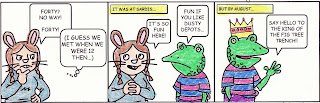
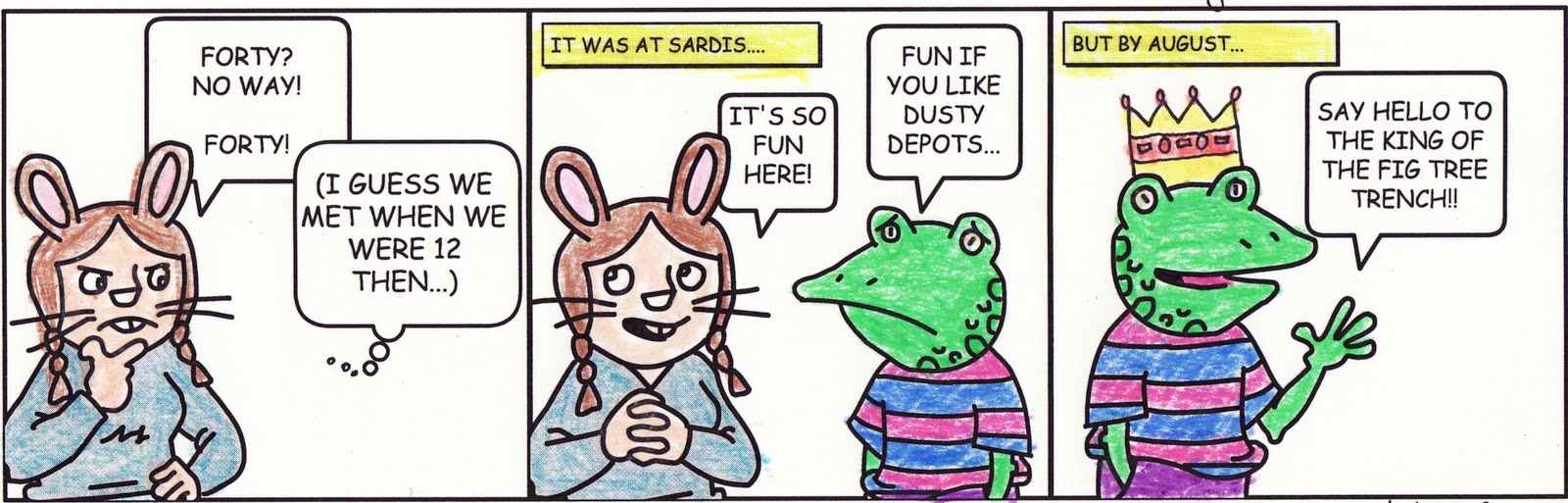
Maria Daniels did hers like a daily newspaper strip, albeit one with a "Life in Hell" funny animal vibe.




Tuesday, November 17, 2009
Mari at school
We interrupt "Birthday Comix week" to link to Mari's nursery school class blog:
http://wnstk.blogspot.com/2009/11/woodland-videosphotos.html
She's identifiable in a few videos, most notably the swinging vine.
http://wnstk.blogspot.com/2009/11/woodland-videosphotos.html
She's identifiable in a few videos, most notably the swinging vine.
Birthday comix
This one is from Chris D'Aveta. He went for the classic one panel. There are some existential Donnie Darko elements, too. If it seems like an obscure reference to an unknown narrative, sorry, but that's the way it is. It makes sense to me, and I'm not going to explain it here.


Monday, November 16, 2009
Birthday comix
I'm 40 today. Over the weekend, we had dinner with some friends and Julie asked them to make comics for/about me. This week: Birthday Comix!
Each of these were made by a friend (or friends) and at the end of the week I'll post the "Exquisite Corpse" Comic made at the dinner party.
Subscribe so you don't miss any exciting issues!
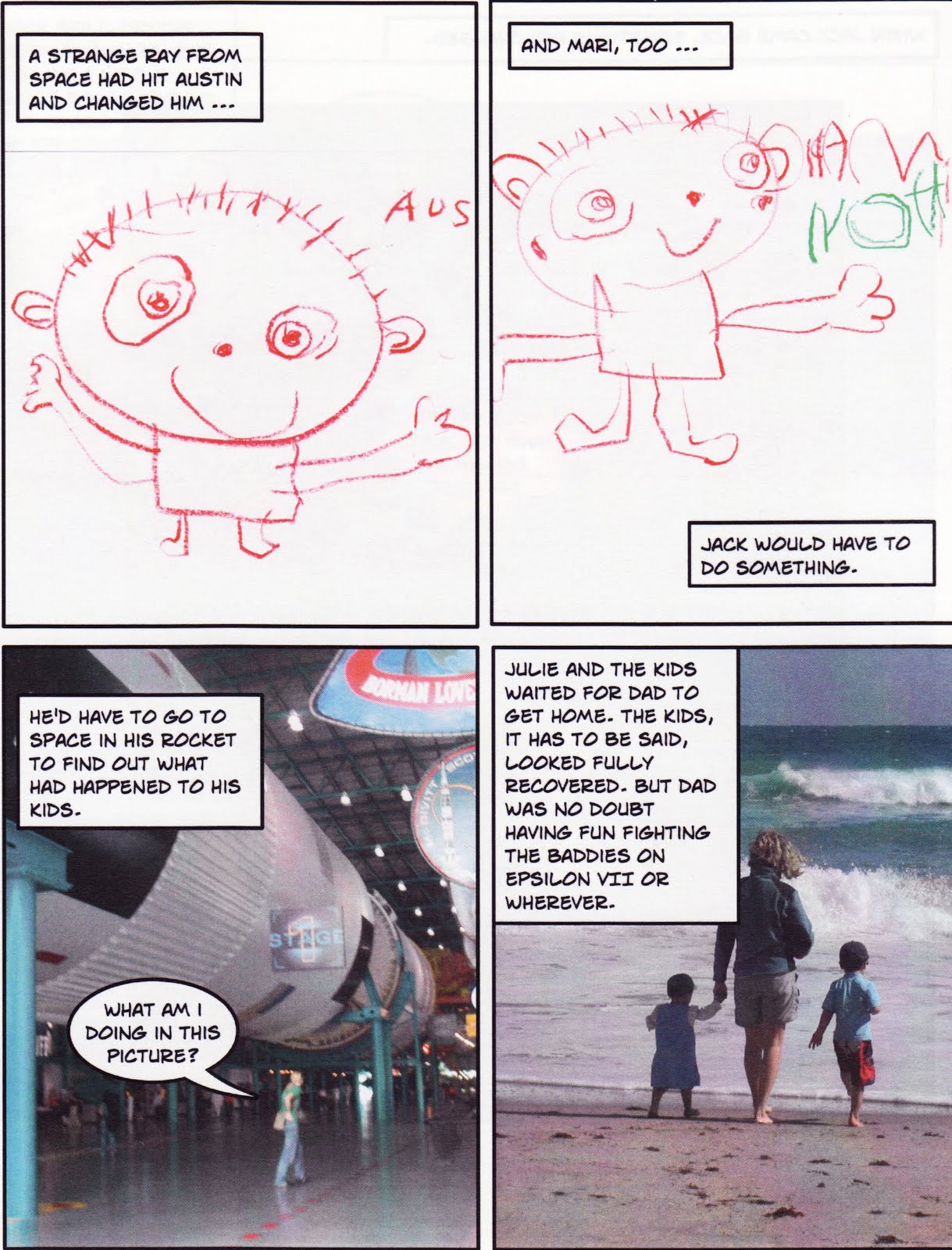
First up, from Gavin Grant and Kelly Link. (I was told Gavin did most of the inside and Kelly punched up the cover). They use the basic superheroic format (and get a lot of mileage out of photos that appeared on this very blog!):
UPDATE: click on the images to enlarge to legible size.



Subscribe to:
Posts (Atom)